The Boy Who Got Lost in Time
In the high folds of the mountain where the wind had long since forgotten mercy,
a boy named Joseph lived with the thin edge of winter pressed against every breath. He was twelve,
though the drought that had lasted years had carved the years deeper into him than into most. The village clung to the slope like a handful of stones that refused to fall. The springs had dwindled to memory. The pastures had turned to grey dust even beneath the snow. And now the snow itself had come, heavy and without kindness,
sealing the world in a white silence that offered no wood and little hope.
Joseph’s mother lay in the single room of their house,
her breath shallow, her skin hot and dry as old parchment. The fever had taken her slowly, the way the drought had taken everything else. There was no father. He had gone years before, into the same mountains that now seemed determined to take the rest of them. Joseph did not speak of him. Speaking of absence only made the room colder.
On the morning the story begins, Joseph rose before the light fully claimed the peaks.
He wrapped his mother’s thin blanket higher around her shoulders,
touched her forehead once with the back of his hand,
and stepped into the hard blue cold. He carried an axe too large for him and a sack that already felt heavy with emptiness. He was looking for wood. Any wood. Roots, broken branches, the skeletons of bushes that had once been green. Anything that would burn long enough to keep the fever from winning.
He climbed higher than he had ever dared in winter.
The path was little more than a suggestion under the snow. The wind moved through the pines like a voice that had forgotten language. When the last of the village roofs disappeared below him, Joseph found the cabin.
It stood half-swallowed by the mountain’s shoulder, its roof sagging, its door hanging open like a mouth that had given up speaking. No one had lived there in living memory.
The old people said it belonged to a time before the drought,
before even their grandfathers. Joseph hesitated only a moment. Cold is a persuasive teacher. He stepped inside.
Dust lay thick as felt. A single shaft of weak light fell across a rough table. On that table, as if placed there only moments before,
rested a copper pocket watch.
It was not beautiful in the way of jewels. It was beautiful in the way of something that had outlasted everything around it. The copper had darkened to the colour of old blood, yet the glass still held a faint clarity. Joseph reached for it without thinking. The moment his fingers closed around the cool metal, a fine trembling rose through his skin, as if every small hair on his arms and neck had remembered a different season.
The air inside the cabin seemed to lean closer. For an instant the world tilted,
not violently, but the way a boat tilts when a wave passes beneath it in the dark. Then the sensation faded. Joseph did not understand what had happened. He only knew that the watch felt warmer than it should, and that leaving it behind suddenly seemed impossible. He slipped it into the pocket of his coat and ran.
He ran the way a boy runs when the mountain itself seems to be listening.
When he reached the place where his house should have been, the snow was gone.
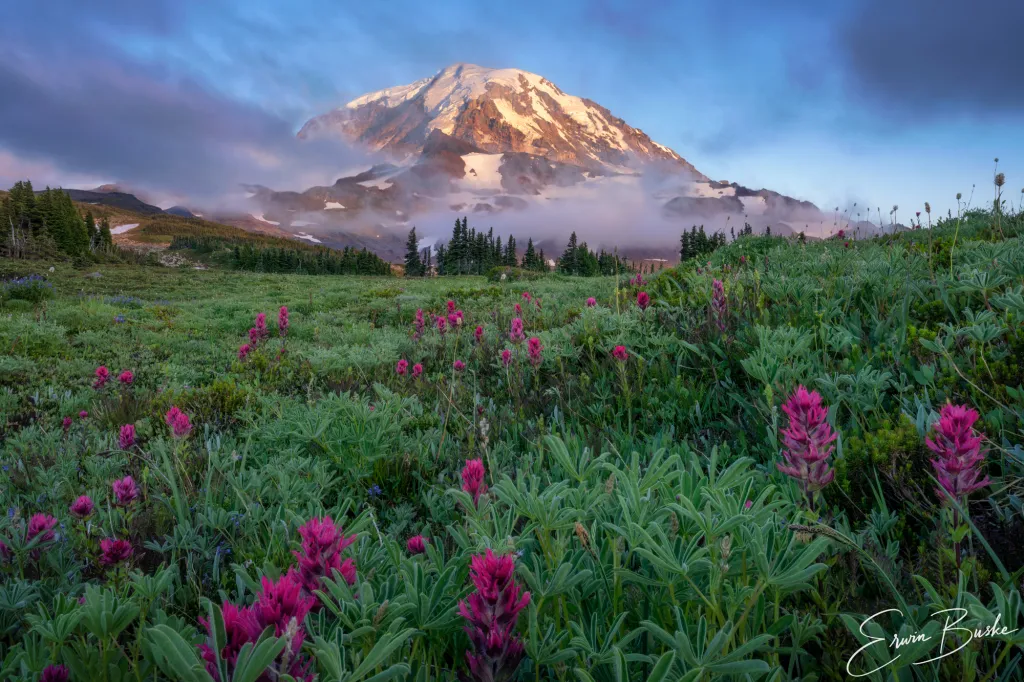
The grass stood high and green, heavy with the weight of its own living. A stream moved through the meadow with a clear, unhurried voice. The air smelled of wet earth and something flowering that Joseph had never seen in his lifetime. The village below looked smaller, younger, its roofs of fresher thatch. Smoke rose from chimneys in thin, hopeful threads.
Joseph stood very still. The copper watch ticked once against his ribs, soft and certain.
He walked the path he had always known and found that the path no longer knew him.
At the edge of the meadow a girl of perhaps seven or eight was gathering wild herbs into a basket. Her hair was the same dark brown as his mother’s. The shape of her face, the particular way she held her shoulders against the light, struck him with a force more precise than recognition. He knew that face. He had watched it age and weaken and grow transparent with fever. Now it was open, curious, still forming.
The girl looked up. Her eyes were clear and unafraid.
“You’re not from the lower valley,” she said. Her voice was the voice of a child who has never yet been told that the world can end.
Joseph could not answer at first. The truth was too large for his mouth. He only nodded.
She studied him a moment longer,
then held out a sprig of something green and sharp-smelling. “For the fever,” she said. “My mother says it helps when the heat comes into the blood.”
Joseph took it. The leaves were cool and living between his fingers. He felt the weight of the watch in his pocket like a second heart.
Over the days that followed—though the number of days was difficult to measure, for time in that place moved with a different gravity—Joseph remained near the village of the past. He did not tell the girl his name. He did not tell her that one day she would grow into a woman who would lie fevered in a house of thin walls while her son searched the dying mountain for wood. He only stayed close enough to watch, and sometimes to help.
He carried water from the stream. He repaired a fence that had begun to lean. He sat with the girl in the long grass while she taught him the names of plants that no longer grew in his own time. In return he told her careful, incomplete stories of a mountain that sometimes forgot how to be kind. She listened with the seriousness of children who have not yet learned that some stories are warnings.
One evening, as the light thinned toward violet, the girl asked him,
“Why do you look at me as if I am already gone?”
Joseph’s throat closed. He looked down at the copper watch, which he had begun to wind each morning though he did not know why. The hands moved steadily, indifferent to the strangeness of their journey.
“Because I have already loved you,” he said at last, the words barely more than breath. “And I am afraid of what the years will do.”
The girl considered this with the grave attention of someone who still believes the world can be understood if only one listens carefully enough. Then she reached out and touched the back of his hand, the same way Joseph had touched his mother’s forehead in another life.
“Then stay,” she said simply. “Until the fear is smaller.”
But Joseph knew he could not stay. The watch ticked against his ribs with increasing insistence, as if time itself had grown impatient. On the seventh evening—or what felt like the seventh—he climbed once more to the abandoned cabin. The door still hung open. The dust still waited. He placed the copper watch back on the table exactly where he had found it.
The trembling returned, finer and deeper this time. The green world tilted. The smell of living water faded. When Joseph opened his eyes again, the snow had returned, and the cold with it, and the thin blue light of a winter that had never learned mercy.
He ran down the mountain path with the empty sack still in his hand. The village was as he had left it—grey, closed, surviving. Inside the single room his mother still lay fevered, her breath shallow. But when Joseph knelt beside her and placed the sprig of green herb (somehow still cool, somehow still living) upon the blanket near her hand, her eyes opened.
She looked at him for a long moment, as if trying to remember something that had never quite happened.
“You were gone a long time,” she whispered.
Joseph did not correct her. He only took her hand, which felt smaller than he remembered, and held it while the copper watch—now returned to the mountain cabin, now perhaps waiting for another lost child—ticked somewhere far above them in the dark.
Outside, the wind moved through the pines. Inside, the fever began, almost imperceptibly, to loosen its hold. Joseph did not know whether the herb had done it, or the memory of green grass, or the simple fact that he had returned carrying something the drought could not touch.
He only knew that the past is never entirely past, and that a boy who has once walked through time will forever measure the present by the light of a meadow that no longer exists—yet somehow still does,
wherever love refuses to forget.
Error happened.


No responses yet